

The Policing Project Commends U.S. Supreme Court Decision in Chatrie v. United States, Urges Lawmakers to Take Action
FOR IMMEDIATE RELEASE: June 29, 2026
MEDIA CONTACTS: Joshua Manson, joshua.manson@nyu.edu
The Policing Project welcomes today’s decision by the United States Supreme Court in Chatrie v. United States, recognizing that geofence searches — a technique through which law enforcement can access detailed location data from mobile devices present near a crime scene — are indeed a “search” under the Fourth Amendment, and thus require a warrant issued upon probable cause.
Emerging surveillance techniques like geofence searches can help solve crimes, but they also create unprecedented risks to privacy and civil liberties. Today, the Court correctly recognized that geofence warrants expose detailed, sensitive location data — including from individuals who have not been involved in any wrongdoing — to law enforcement perusal at the click of a button. This is precisely the type of intrusion which the Fourth Amendment is designed to protect against.
At the same time, by declining to rule on whether the particular, three-step geofence warrant process at issue in Chatrie was itself constitutionally sufficient, today's ruling leaves unanswered the question of what a reasonable, constitutionally-grounded geofence search might look like.
We need not wait for the courts to determine the answer; the difficult questions raised by modern data surveillance should not be resolved through judicial decisions alone. And, in particular, the decision in Chatrie focuses only on questions surrounding the warrant requirement. Law enforcement use of personal information requires more comprehensive regulation.
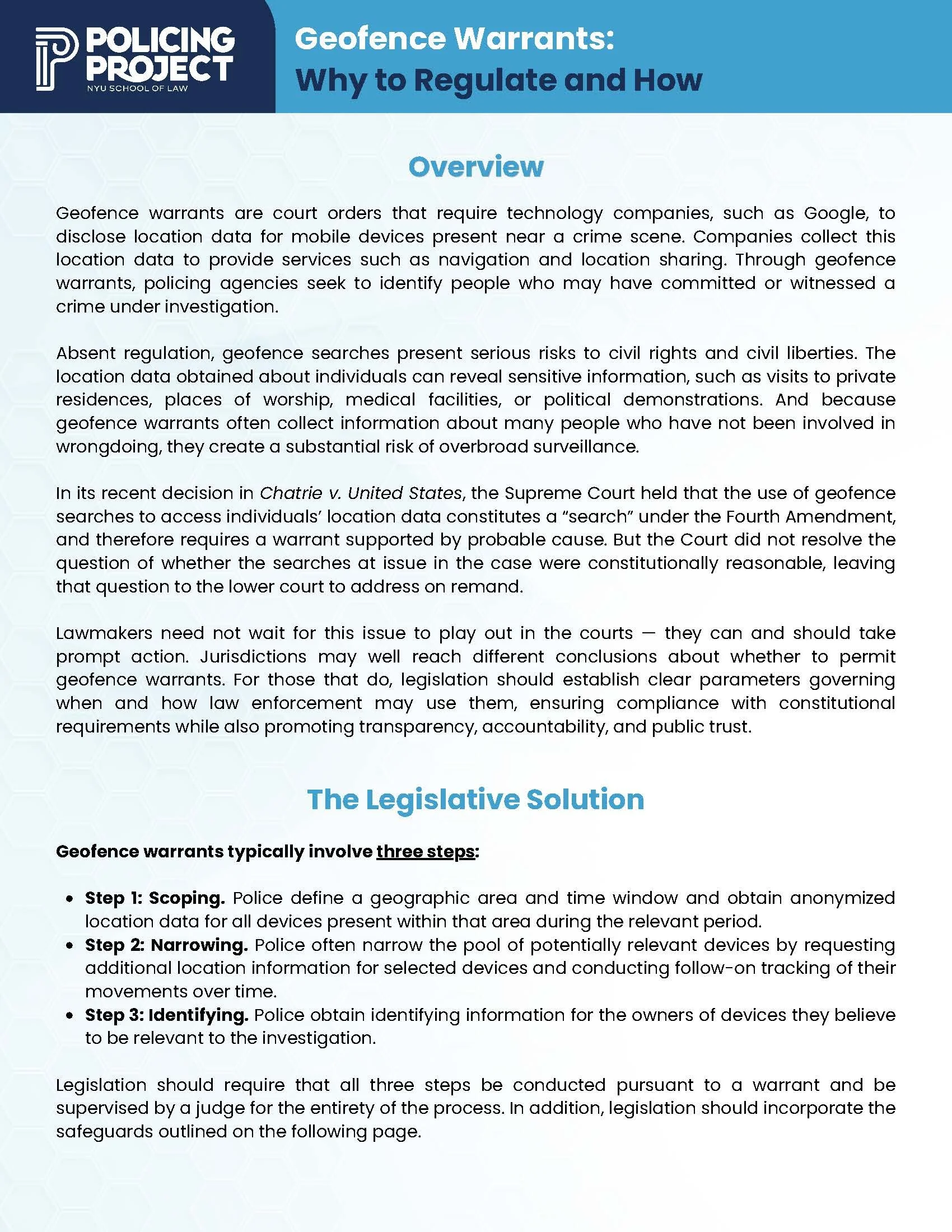
Geofence Warrants: Why to Regulate and How
Legislatures remain best positioned to establish detailed rules governing whether and when these data surveillance tools may be used, what safeguards must apply, how data may be retained, and what oversight mechanisms should exist.
The Policing Project urges lawmakers across the country to enact comprehensive guardrails for geofence warrants and other forms of data surveillance that protect privacy while preserving access to legitimate public-safety tools.
Today, we are publishing a resource on how and why to regulate geofence warrants to support those efforts.
Notably, geofence warrants are part of a broader trend in which police have gained access to vast repositories of information — about our movements, activities, relationships, and much more. It is long past time for lawmakers to take steps to rein in this indiscriminate data surveillance. Regulating geofence warrants is a vital first step.